Drive Into Fall

Ethan Sullivan
| 28-04-2026
 · Travel Team
You're driving and suddenly the road ahead just disappears into a tunnel of red, orange, and gold. Trees line both sides like they've been set on fire — slowly, beautifully, all at once.
The yellow centerline stretches forward and curves gently into the hillside, and somewhere behind those blazing maples, a blue mountain ridge sits quiet in the distance.
This is Vermont in autumn, and no photo — not even a really good one — fully prepares you for what it looks like in person. The colors are just louder than you expect.
Why Vermont Wins Every Fall
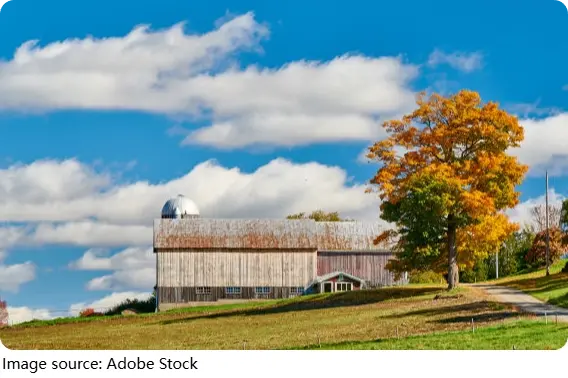
New England as a whole puts on a spectacular show each autumn, but Vermont consistently takes the crown. The reason comes down to tree species: sugar maples dominate Vermont's hillsides, and when they turn, they go full crimson — not just orange, not just yellow, but a deep saturated red that stacks up against the evergreen pines and makes the whole landscape look like it's glowing from inside.
Add rolling farm fields, covered bridges, white chapel steeples, and mountains that top out around 4,000 feet, and you have a setting that feels almost unreasonably picturesque.
Peak color typically hits northern Vermont in late September to early October, working its way south through mid-October. Higher elevations turn first, which means mountain passes can be at peak while valley towns are still mostly green — a useful thing to know if you're trying to plan your timing.
The Route Worth Taking
Route 100 is Vermont's most celebrated scenic highway, running north-south straight through the heart of the Green Mountains. It passes through small towns like Waitsfield, Warren, and Stowe, with the kind of main streets that have independent bookshops, farmstand cider, and general stores that sell Vermont maple syrup by the jar.
From Stowe, the Smugglers' Notch road cuts west through a dramatic mountain pass — narrow enough that RVs aren't allowed, flanked by enormous boulders and sheer rock walls draped in fall color. It's one of those drives where you keep stopping because every bend reveals something worth photographing.
For a longer loop, combining Route 100 with a stretch of Route 2 or the Champlain Valley Byway along Lake Champlain gives you coastline, farmland, and mountain views all in one trip.
Vermont
Getting There and Getting Around
Most people fly into Boston Logan International Airport or Burlington International Airport (BTV), Vermont's main hub. Burlington is the easier starting point if you want to dive straight into foliage country. Car rentals are essential — book well in advance, as demand spikes sharply during leaf season and prices reflect it. Budget around $60–$120 per day for a rental depending on timing and vehicle type.
Gas up before heading into rural stretches of Route 100 — stations thin out between towns, and you don't want to be calculating mileage while staring at orange hillsides.
Where to Stay and What It Costs
Stowe is the most popular base, with options across every budget level. The Lodge at Spruce Peak sits at the mountain base with rooms from around $300–$450 per night in peak season. For something cozier and more local, smaller inns and B&Bs throughout the Mad River Valley run $130–$220 per night and often include breakfast — which matters more than you'd think after a cold morning hike.
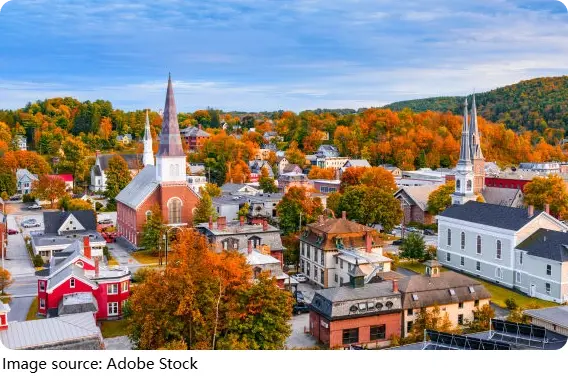
Woodstock, Vermont is another excellent base: a picture-perfect town with a covered bridge, a village green, and a main street that looks like it was designed specifically for autumn. Inn rates there start around $150–$250 per night.
Book accommodation at least two months ahead for October visits. The best rooms go fast, and the foliage doesn't wait for anyone.
One Thing You Shouldn't Skip
The Stowe Gondola Skyride at Mount Mansfield lifts you above the tree canopy to Vermont's highest peak at 4,393 feet. From up there, the whole valley spreads out below in every shade of fall at once. Tickets run about $39 per person, and the views justify every cent — especially on a clear morning when you can see all the way to the Adirondacks across Lake Champlain.
A fall drive through Vermont is one of those experiences that earns its reputation completely. The road doesn't just take you somewhere — it is somewhere.